


My Role
Concept & Interaction Designer
Physical Prototyper
Tools




Duration
3 Months
Worked Alongside
Agnes Kloos,
Moritz Schuker,
Paula Trummer,
Challenge
How might we communicate the ecological impact of the cane toad without overwhelming visitors with information?
Context
The project was created for the Natural History Museum in Stuttgart. The cane toad was introduced to Australia by humans and became an invasive species with serious consequences for the ecosystem.
What tools did we use for a 3 Month project?
Crazy Eight
10 Min Sprints
Idea Tower
Storytelling
Wireframing
User Flow
Prototype
Arduino
Reed Sensors
Magnets
ProtoPie
Projector
Visitors decide what to explore, make connections and reflect on their own relationship with nature. The exhibition should help visitors understand:
Why the cane toad was brought to Australia?
How it spread and affected native species?
Why these issues need discussion rather than simple answers?
Finding the Topic
We began by researching how human intervention can disrupt ecosystems. This led us to invasive species and, specifically, the cane toad: introduced to Australia to control pests, it instead became a threat to native wildlife.
The research showed that the topic was not only about ecological damage. It also raised a more difficult question: How should people respond when a human decision has already changed an ecosystem?

Creating the Idea
To translate this complexity into an exhibition, we explored early ideas through a 10 minute sprint, Crazy 8s, sketches and storyboards. We tested different ways of structuring the information around time, place and human influence.
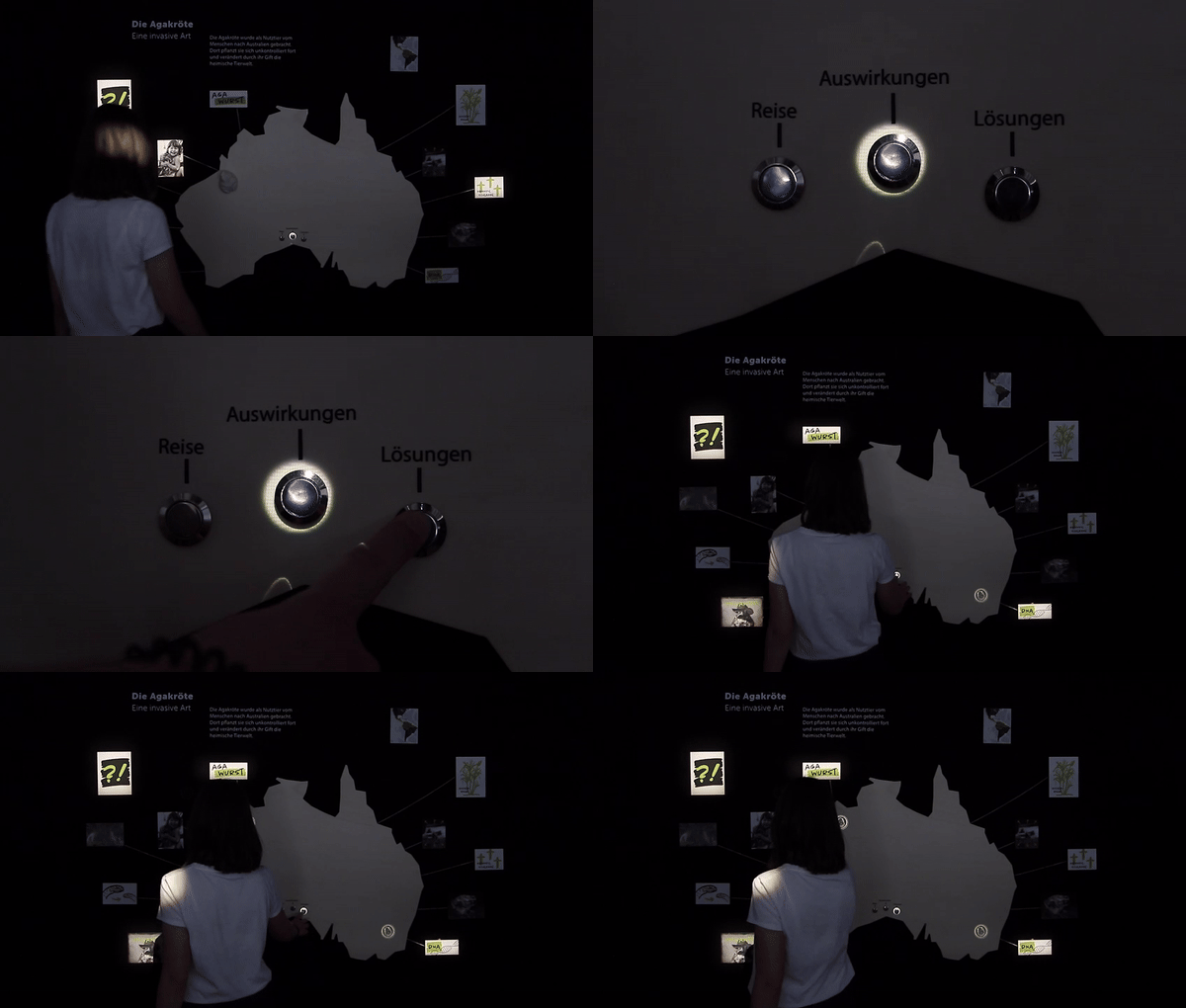
We designed a physical digital exhibition around a map of Australia. The map became the central interface. The story was structured into three chapters:
The journey:
Why the cane toad was brought to Australia and how it spread.
The impact:
How its introduction changed ecosystems and affected native wildlife.
Possible responses:
Which approaches can contain invasive species and which questions remain open

How to call up content?
The cane toad itself was the interaction tool. Visitors placed or moved it onto different areas of the map. Each location activated a new piece of information, including:
Short texts
Audio
Video
Animations
Images

The Reed-Sensor
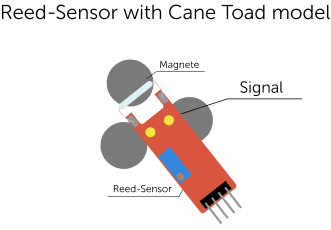
The reed sensor is ideal for detecting the presence of an object with a magnet. To ensure flawless signal transmission to the interface, the sensor must be positioned precisely to the millimeter, close to the magnets, and should not switch to HIGH. Only when the sensor is appropriately placed should a signal be sent to Protopie Connect.


Projecting the content
The exhibition content is projected directly onto the map, with one projector placed close to the surface to minimise shadows from visitors. A second projector, positioned around two metres behind it, illuminates the chapter cards so all information remains clearly visible.
Testing
On the first day, we noticed that some people did not immediately understand that the cane toad was the interactive object. The system worked technically, but the invitation to interact was still too subtle.
Adjustment
We adjusted the visual cues and made the interactive icons more inviting. On the second day, visitors understood the interaction faster and explored the content more independently.